A forecasting model, a trading dashboard, and a window into the model's head, in one thing you run yourself.
🧠
Always learning
It trains online as its forecasts mature, pages months of history into itself overnight, and keeps five percent of what it has seen out of training to catch itself overfitting. When it has no real edge it holds, instead of trading noise.
🧪
Weekend backtest
Every weekend a fresh net walks the whole history day by day, forecasting each day before it trains on it, with the live policy deciding and the realised returns keeping score. Out of sample by construction, with the report on its own tab.
🔁
A universe that keeps itself current
Your holdings are always modeled. Each day after the close the most interesting names in the market, by moves, by what the press is naming and by what the big funds hold, are promoted into the remaining slots and retired when they go quiet. The model keeps what it learned about every name that stays.
📈
Live charts
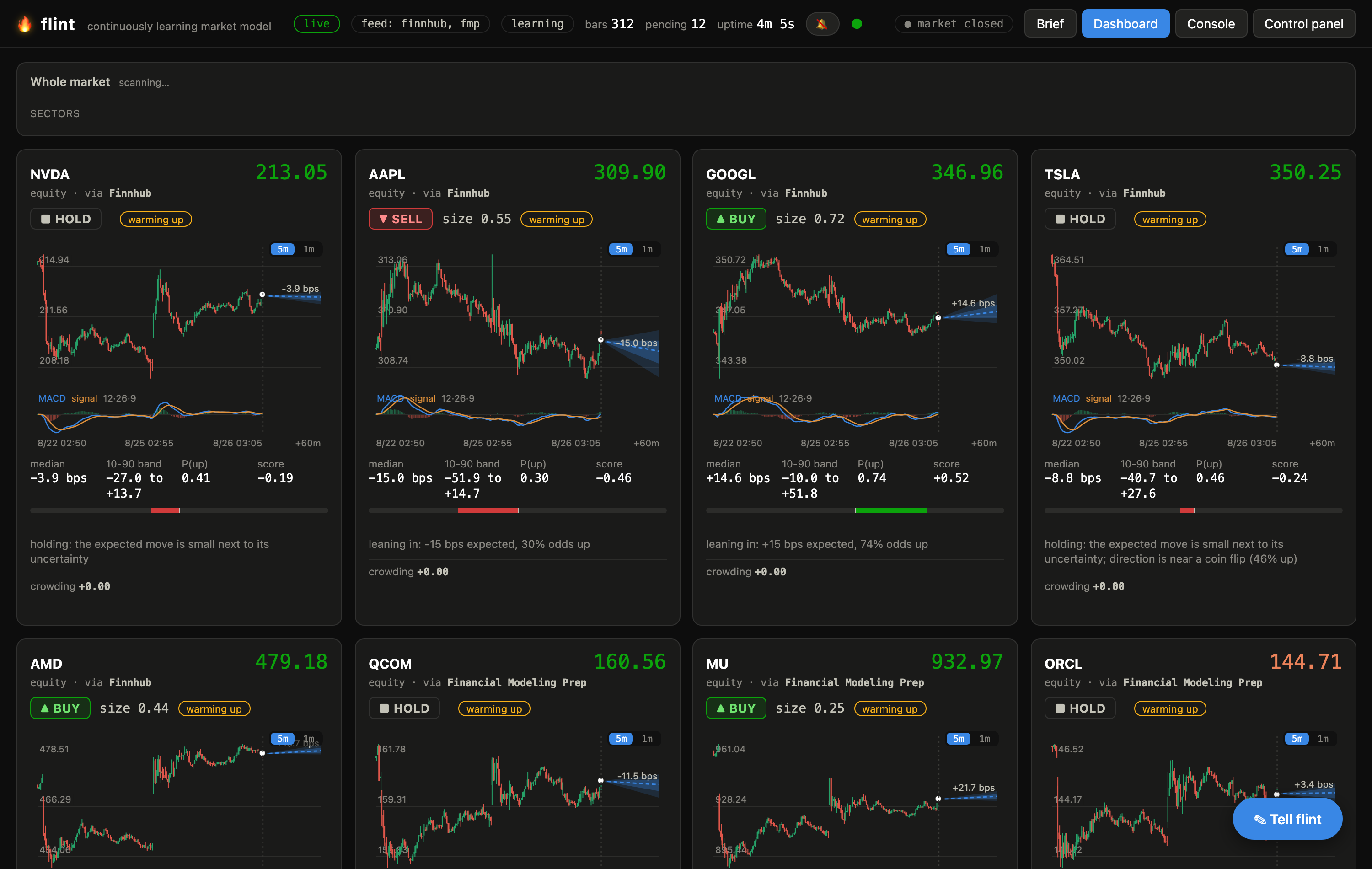
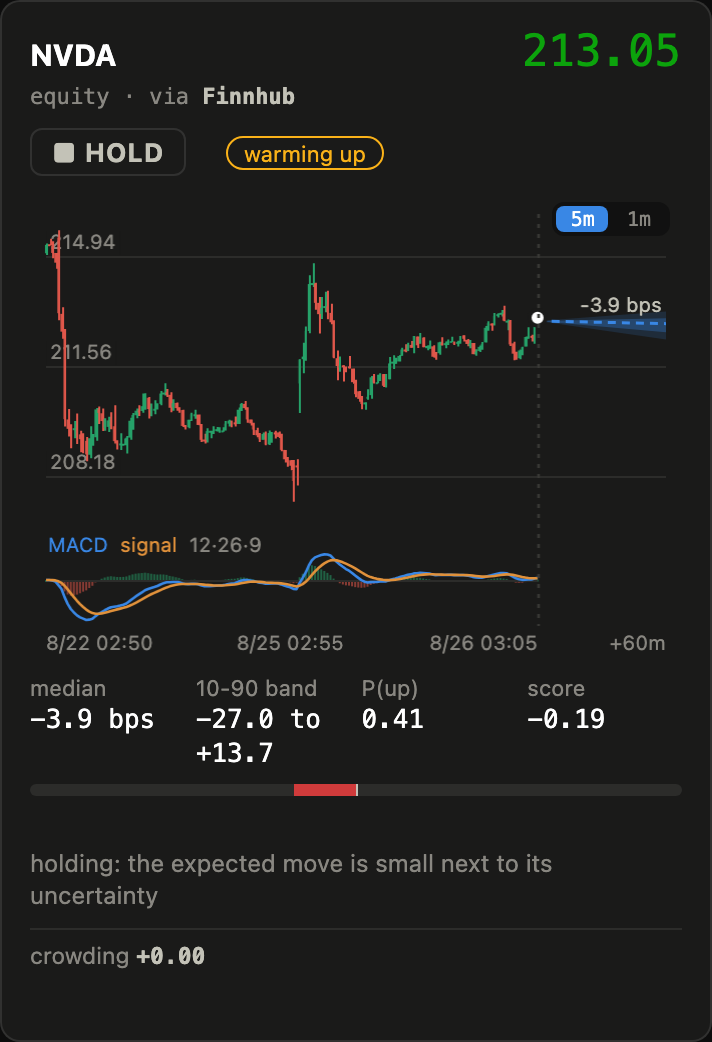
Every stock gets a candlestick chart with MACD and a forecast fan. Cards rank by urgency and reorder in real time, the top fifty render first, and any chart flips between 5 and 1 minute bars.
🔍
Everything about a name
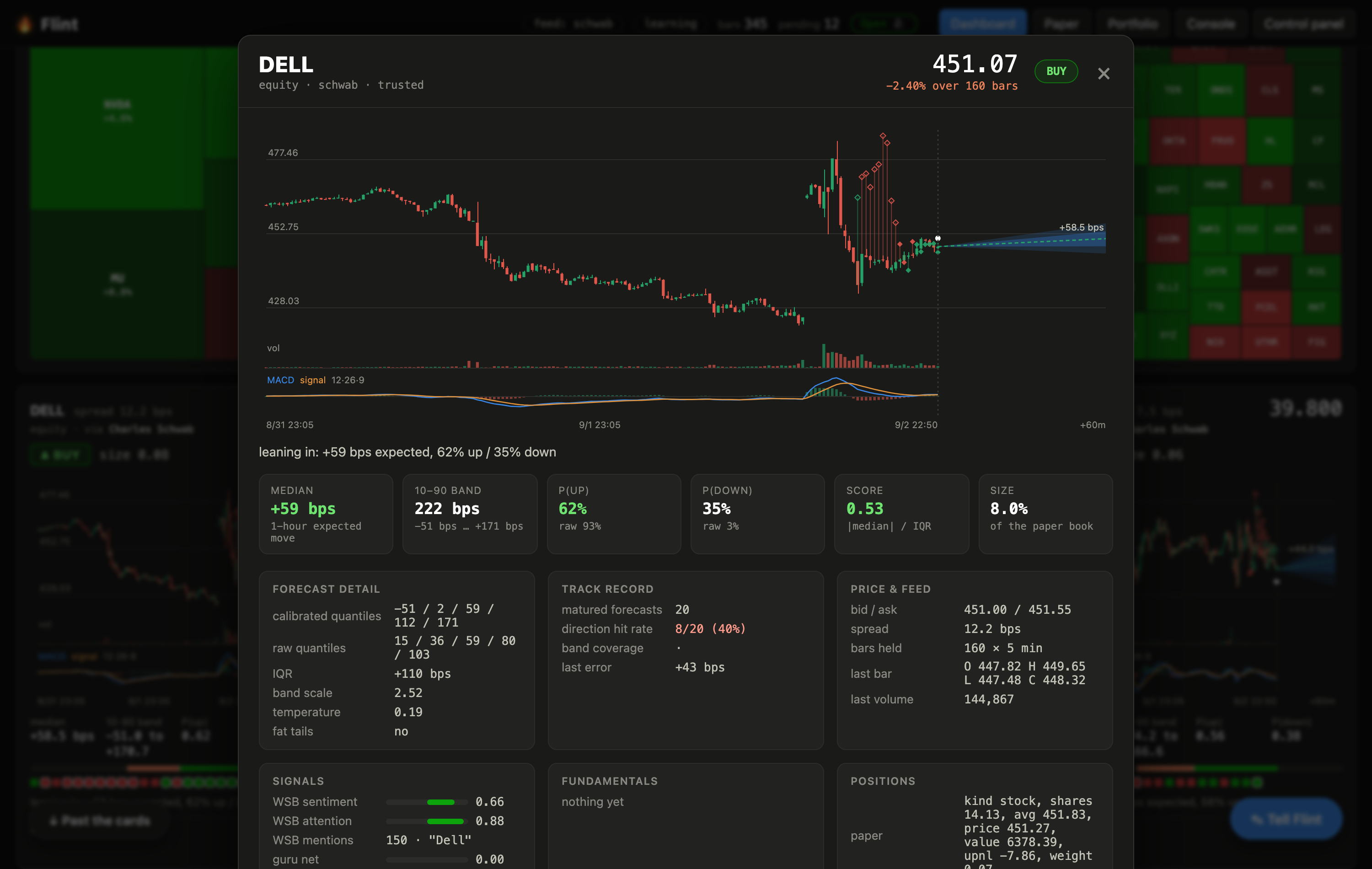
Click any ticker anywhere, a card, the heatmap, a holding, a 13F line, and a detail view opens: a big chart, the calibrated forecast, its track record, signals, fundamentals, news and positions. The URL follows, so back and refresh work.
🗺️
Market heatmap
The movers radar draws as a treemap, area by market cap and colour by change, grouped by sector, trimmed on the fly so every block carries its ticker.
🔦
See it think
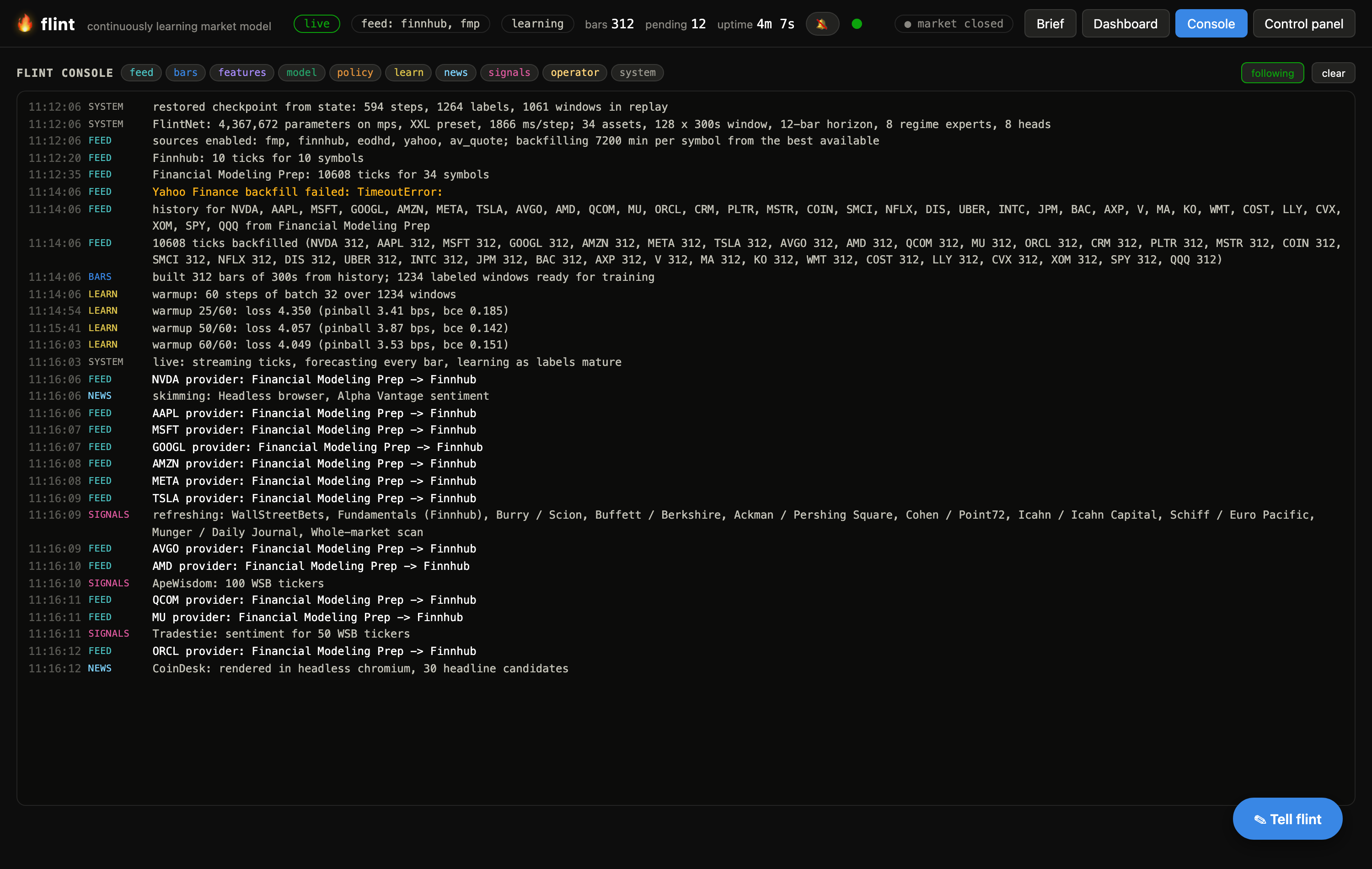
A control panel streams the model's consciousness across seven consoles, and a Console tab tails everything at once: the feed, the features, the forecasts, the policy, the training. Every gate and budget is a live control.
📝
On-device brief
Small models summarize the tape, the macro backdrop, positioning and the smart money. A larger local model turns those notes into a plain newspaper column. It talks to a local model server, llama.cpp or Ollama, so nothing leaves the machine.
🏛️
Investor council
A panel of well-known investors, built from their real 13F filings and documented style, nudges the model. Burry, Buffett, Ackman, Icahn and others.
🛰️
Whole-market radar
Breadth, sector rotation, volatility and a large movers watchlist give you and the model the full picture. Penny and small-cap movers included.
🔒
Local and private
Everything runs on your machine. API keys sit in gitignored files and only ever talk to their own provider.
⚙️
Fits your machine
A first-run benchmark sizes the network to your hardware and uses the GPU when there is one, Apple silicon or NVIDIA, so it runs on a laptop, a workstation, or a DGX Spark. Memory is budgeted, not hoped for: the replay has a byte budget, one training job owns the GPU at a time, and a floor stays free.